Oval engagement ring settings: style and protection explained
An oval diamond has a long, elegant shape that many shoppers find flattering on the finger. But that same shape comes with a practical challenge: the pointed ends are more exposed than the rounded edges of a round brilliant. Choosing the right setting is not just about looks, it directly affects how well the diamond stays secure over years of daily wear. This article walks through the main setting styles for oval diamonds, explains how each one handles protection, and helps you decide which approach fits your priorities.
Why oval diamonds need a different kind of setting
A round diamond distributes impact evenly around its girdle because the shape is symmetrical in every direction. An oval diamond, by contrast, has two narrow tips that stick out. Those tips sit right at the top and bottom of the stone when it is set in a ring. If the setting does not cover or guard those points, a hard knock or a catch on clothing can chip the diamond. The risk is real, but it is manageable with the right design.
The second factor is the oval's length-to-width ratio. Longer ovals (say, 1.45 or 1.50 ratio) have more protruding tips. Wider ovals (1.30 or 1.35) are a bit more forgiving. Regardless of ratio, the setting must hold the diamond firmly so it does not twist or shift. A loose diamond in any shape is vulnerable, but an oval that rotates can put a tip directly in harm's way.
The classic solitaire: elegance with careful prong placement
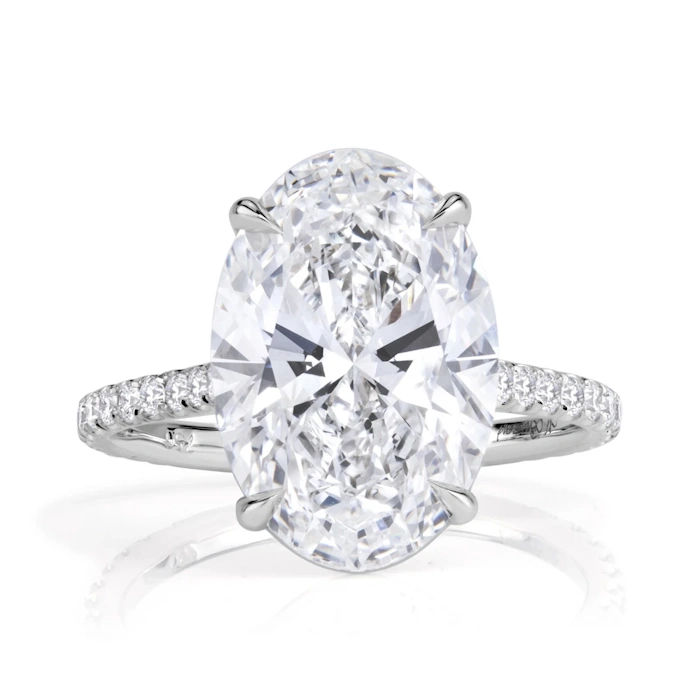
A solitaire setting uses a band with a head that holds the diamond with prongs. For an oval diamond, the number and placement of those prongs matters a lot. A standard four-prong solitaire positions two prongs at the tips and one on each side. That leaves the tips covered, but the side prongs can be set slightly lower on the diamond to avoid hiding the shape. Many jewellers prefer six prongs for an oval: two at the tips and two on each long side. Six prongs add extra security and also reduce the chance of the diamond shifting if one prong gets bent.
What to watch for in a solitaire: make sure the prongs at the tips are thick enough to absorb a bump without bending. Thin, delicate prongs may look pretty, but they are the first thing to fail on an oval. You can ask to see the ring from the side, the tips should be fully enclosed by metal, not hanging out over empty space. A well-made solitaire is one of the most common settings that protect oval diamonds, as long as the prongs are proportionate to the stone.
The halo setting: extra metal around the diamond
A halo setting surrounds the centre diamond with a ring of smaller diamonds or gemstones. That ring adds a layer of metal and small stones that act as a buffer. If the ring hits a countertop or a door frame, the halo takes the impact, not the diamond tips. For an oval diamond, a halo works especially well because the shape of the halo can mirror the oval outline, creating a continuous protective rim.
There are two common halo styles for ovals: the single halo, which has one row of stones around the centre, and the double halo, which has two rows. The double halo offers even more coverage, but it also adds width to the ring. Some buyers feel a double halo makes the ring look larger, while others prefer the cleaner line of a single halo. Either way, the halo itself needs to be set securely. Loose melee stones in the halo can fall out, and a missing stone leaves a gap that can catch on fabric.
Because the halo adds metal around the entire perimeter, it is one of the most reliable settings that protect oval diamonds. The centre diamond is essentially cradled by the halo structure. If you plan to wear the ring every day and work with your hands, a halo setting is a practical choice that does not sacrifice style.
The bezel setting: full metal enclosure
A bezel setting wraps a rim of metal completely around the diamond's girdle. For an oval diamond, this means the tips are fully covered by metal on both ends. Nothing protrudes. The diamond sits inside a metal collar that holds it securely from all sides. This is the most protective setting available for any diamond shape, and it is especially valuable for ovals.
The trade-off is visibility. A bezel hides part of the diamond's edge, which some buyers feel reduces the sparkle. Modern bezel settings use a thin metal rim that shows more of the diamond, but the rim is still there. If you love the oval shape and want maximum security, a bezel is hard to beat. It also keeps the diamond from snagging on sweaters or gloves, which is a common complaint with prong settings.
Some bezels are full, covering the entire girdle, and some are partial, leaving the tips exposed. For an oval, a full bezel is the safer option. A partial bezel might leave the tips vulnerable, which defeats the purpose. If you choose a bezel, confirm that the metal covers both pointed ends.
The three stone setting: side stones as tip guards
A three stone setting places the oval centre diamond between two smaller diamonds or gemstones on either side. The side stones sit right next to the oval's tips. In a well-designed three stone ring, the side stones overlap the tips slightly, so the tips are never the outermost point of the ring. If the ring bumps into something, the side stones hit first.
This design works particularly well for longer ovals, where the tips extend far beyond the band. The side stones can be round, pear-shaped, or even trapezoid. Round side stones are the most common and they create a soft, continuous curve. Pear-shaped side stones echo the oval's shape. The key is to have the side stones set close enough to the centre diamond that there is no gap where a tip could catch.
The three stone setting also has a symbolic meaning, past, present, future, which some buyers appreciate. But from a practical standpoint, the protection it offers depends on the stone sizes. If the side stones are too small, they do not cover the tips. If they are large, they add visual weight. It is a good middle ground between a solitaire and a halo.
Pavé bands and diamond shoulders: adding security along the sides
A pavé band is covered with small diamonds set close together. While the band itself does not protect the centre diamond directly, it can be combined with a setting that does. For example, a solitaire with a pavé band still relies on the prongs for tip protection. Diamond shoulders, small diamonds set into the top of the band next to the centre stone, can add a bit of visual shielding, but they do not replace proper prong or bezel coverage.
If you like the look of a sparkly band, consider a setting that already has strong tip protection, such as a halo or bezel, and then add pavé to the band. That way the ring is both secure and luminous. Avoid a pavé band alone with a four-prong solitaire if you are worried about the tips, because the band does nothing to guard them.
How to check for protection when shopping
When you look at an oval engagement ring in person or online, you can check a few things quickly. First, see if the tips are covered by metal. For a prong setting, both tips should have a prong over them. For a bezel or halo, the metal should wrap around the tips. Second, look at the profile, the side view. The diamond should sit low enough that the tips are not sticking out above the metal. A high-set diamond is more likely to get hit. Third, check the prong thickness. Thin prongs are a risk. A good rule is that the prong at the tip should be at least as wide as the prong on the side.
Finally, consider your daily activities. If you type a lot, lift weights, garden, or work with tools, a protective setting like a bezel or a double halo might be the better long-term choice. If you mostly wear the ring for dress occasions, a solitaire or three stone setting with well-placed prongs is fine.
Balancing style and security
Every setting style has a different balance of visibility and protection. A solitaire shows off the diamond the most but puts more responsibility on the prongs. A halo adds a ring of stones that both decorates and protects. A bezel hides the most diamond but offers the highest security. A three stone setting uses side stones as guardians for the tips.
There is no single best choice, it depends on how much risk you are comfortable with and what look you prefer. The important thing is to know that the oval shape requires attention to the tips, and that a setting chosen without considering the tips can lead to a damaged diamond later. By matching the setting to your lifestyle and your taste, you get a ring that looks beautiful and stays safe for decades.